How to track restaurant community donations in 30 days
How to track restaurant community donations (and finally know what they cost you)
Every April, without fail, the requests start stacking up. Spring galas, end-of-season sports banquets, school council fundraisers, community 5K races looking for a restaurant sponsor. Some get handled at the door. A few get passed to head office. Others get approved on gut instinct, logged in a notebook, and never followed up on. By the time May wraps up, you've given away gift cards, vouchers, and sponsorship packages worth thousands of dollars, and if someone asked how many donation requests came in this spring, you'd have to guess. Learning how to track restaurant community donations doesn't require new software. It starts with 30 days and one honest spreadsheet.
To track restaurant community donations effectively, operators should record every incoming request, the value of what was given, the recipient organisation, and whether the recipient visited within 60 days. Over 30 days, this data reveals the true cost of community giving and creates the foundation for measuring restaurant donation ROI across locations.
What's actually sitting on your invisible P&L line?
Industry patterns suggest that multi-location restaurant groups in Ontario give away between $10,000 and $20,000 annually in donations, gift cards, and sponsorships. That estimate is directional, but working with Ontario restaurant groups, it tends to be conservative once operators actually run the numbers.
None of that typically appears on a profit and loss statement as its own line. It's scattered across comp costs, marketing budgets, miscellaneous expenses, or it's not tracked at all. Operators know, in a general sense, that they give. They don't know what they've given, who received it, or what, if anything, came back.
That gap is what we call the Invisible P&L Line. It's the real cost of community giving that has never been made visible.
The problem isn't generosity. Generosity is good business. The problem is operating without visibility.
Why operators can't answer basic questions about their own giving
Ask a multi-location operator how many donation requests came in last month. Most will estimate. Ask them how many they approved, and they'll estimate again. Ask how many of those recipients actually came back to the restaurant, and the answer is almost always: "I have no idea."
This isn't a failure of attention. It's a failure of infrastructure. When donation requests arrive by email, through the front door, through a manager's DMs, or via a form on the website, and approvals happen through a text to the owner or a sticky note left for the next shift, no data is being created. The decisions exist. The money moves. But nothing is recorded.
RestaurantsCanada has noted that Canadian restaurants operate on average net margins of 3 to 9 percent. At those margins, $15,000 in untracked giving isn't a rounding error. It's meaningful. And the operators handling it least strategically are often the ones who care most about their communities.
How to track restaurant community donations in 30 days
The 30-Day Donation Request Audit is a structured tracking exercise, not a software rollout. It doesn't require changing how you handle requests. It requires recording what's already happening.
For 30 days, every donation request that reaches any of your locations gets logged. Every one. The ones that get approved, the ones that get declined, the ones that get set aside because it was a Friday dinner rush and nobody had time.
What to capture for every request
The audit template captures fourteen fields per request: date submitted, location, status (approved, declined, or pending), donation amount, requestor name, email, phone number, organisation name, donation purpose, event name, event date, registered charity number, whether a donation letter was provided, and a comments field.
That last cluster, charity number and donation letter, matters more than it looks. In Canada, charitable tax receipts have compliance implications, and knowing whether a registered number was provided at intake is information you'll want when your accountant asks. Most manual systems miss it entirely.
The status field is where the follow-up discipline lives. A request that sits at "pending" for three weeks isn't a decision, it's a delay with a cost attached. The template makes that visible.
For the redemption question, whether the recipient actually visited, that data won't complete itself. For the audit period, the goal is to create the habit of going back and checking. A tracked digital voucher solves this problem at the system level, because redemption is recorded automatically at the point of use. But even during a manual 30-day audit, one follow-up check per request at the 60-day mark is enough to start building a redemption rate you can actually stand behind.
What 30 days of data tells you about restaurant donation ROI
After 30 days, most operators are surprised by two things: how many requests actually came in, and how inconsistently they were handled across locations.
You'll be able to answer questions you've never been able to answer before. How many requests did we receive? What was the total value of what we gave? What percentage of recipients have we seen back since? Which location is receiving the most requests, and is it the one best equipped to handle them?
For multi-location groups that do not centralize their donation requests through a head office, the cross-location comparison is often the most revealing part. One location approves nearly everything. Another declines most requests without logging them. A third passes everything to head office and loses two weeks on every decision. None of those patterns is visible until the data exists.
That data is the foundation for restaurant donation ROI. You can't measure return without first knowing cost. The 30-day audit establishes the denominator.
What visibility changes
Operators who complete the audit typically reach one of two conclusions. Some discover their giving is generating genuine community goodwill, that recipients come back, bring their networks, and the relationship has real value even when it's been unmeasured. Others discover the opposite: significant value leaving the business with no visible return, handled inconsistently, with recipients who have never returned.
Both outcomes are useful. The first validates generosity and gives operators the data to do more of it intelligently. The second creates the case for a different approach: structured intake, tracked digital vouchers, and a follow-up system that closes the loop.
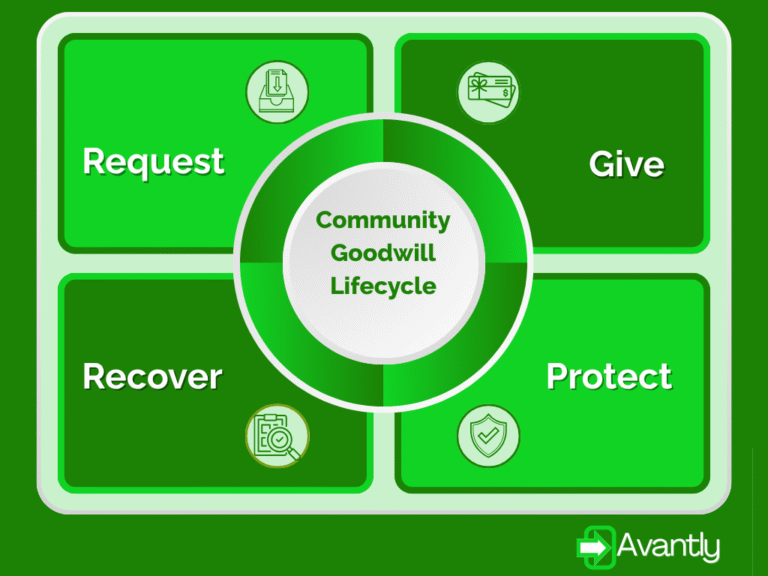
The Community Goodwill Lifecycle starts with a request. It ends with a guest who's been given a reason to return. Getting from one end to the other requires knowing what's in the middle.
Avantly
This won't tell you everything. Thirty days won't capture seasonal variation, and it won't account for relationships built over years with organisations your managers already know by name. But it closes the gap where most operators are currently flying blind, and that's where the work starts.
How to use the audit template
The template is structured as a simple spreadsheet with one row per request. It includes the fourteen fields listed above, including column for adding notes. The intent is to track all request for a 30 day period or one month.
You can run it at one location or across all of them simultaneously. Running it across all locations produces the most useful data, but even a single-location pilot is enough to see the pattern.
Share it with your location managers before the 30 days begin. Let them know the purpose isn't to monitor their decisions — it's to understand what the business is actually giving. Most managers, when they understand that, are relieved to have a system. They've been making donation decisions without support for years.
This varies by location, neighbourhood, and time of year. Based on patterns observed working with Ontario multi-location restaurant groups, a single busy location may receive 5 to 25 requests per month during peak periods like April and September. Most operators have never counted, which is precisely why the 30-day audit is the right starting point.
Restaurant donation ROI depends on whether giving is tracked, whether digital vouchers are used, and whether there's any follow-up with recipients. Operators using tracked digital vouchers report redemption rates that make community giving a measurable acquisition channel rather than an untracked cost. Without tracking, ROI is effectively zero, not because the giving has no value, but because the value is invisible.
No. The audit template is a spreadsheet. It requires no software installation, no POS integration, and no technical setup. It is a structured data collection exercise. After 30 days, the data you've gathered will help you decide whether a more automated approach makes sense for your group.
The audit is designed to add less than two minutes per donation request. For a location receiving 15 requests per month, that's roughly 30 minutes of additional time across the full 30 days. The purpose is to create data that makes their decisions easier going forward, not to add process for its own sake.
Taking the time to understand this area of your business may identify an opportunity to improve your operations and actually create more time for your managers.
Summarize all of your spreadsheets and donation requests. Calculate your total giving cost and your redemption rate. Identify which locations had the highest request volume and which had the lowest follow-through. Then make one decision: is the current approach serving the business and the community, or is it time for a more structured system?