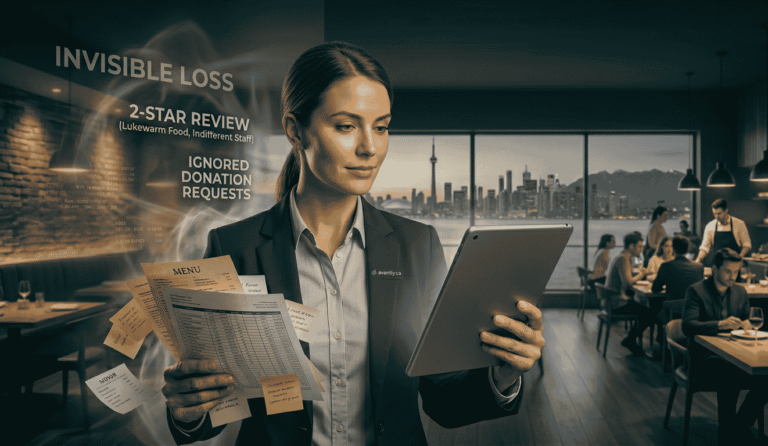
The 4 Stages of Restaurant Community Engagement (and Where Most Groups Get Stuck)
Spring arrives and the donation requests start. A school parent comes in during the Saturday lunch rush. A soccer association emails head office. A local fundraiser contacts two of your locations on the same day, and each manager handles it differently. One says yes. One says maybe. Neither writes it down.
That's not a generosity problem. It's an operations problem. And most multi-location restaurant groups are still solving it the same way they were five years ago: one request at a time, with no system connecting what they give to what they get back.
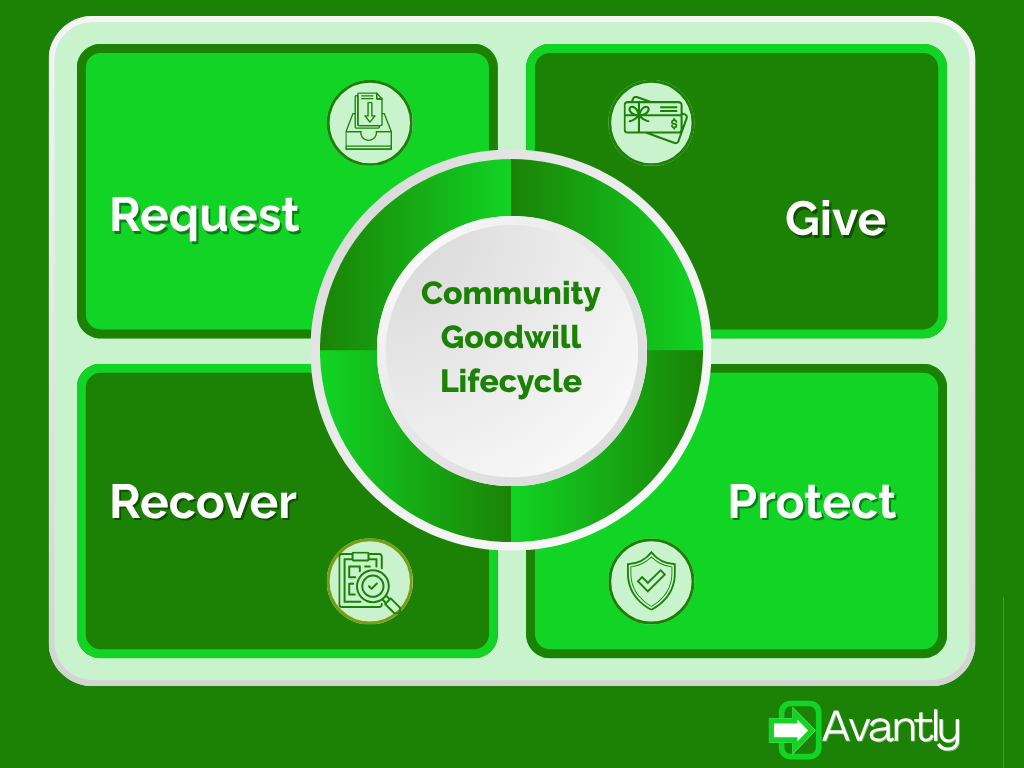
A complete restaurant community engagement strategy follows four stages: receiving and routing donation requests (Request), issuing tracked digital vouchers (Give), recovering dissatisfied guests before they post publicly (Recover), and converting satisfied guests into public reviews (Protect). Most operators handle these as separate problems. The Community Goodwill Lifecycle™ connects them as one workflow, making restaurant community giving ROI measurable for the first time.
The four stages exist in your operation whether or not you've named them. The question is whether you're running them as a connected system, or as four separate things your managers handle differently depending on the day, the location, and whoever picks up the phone.
Why donations, guest recovery, and reviews are the same operational problem
On the surface, these look like three different functions. Donations get handled by whoever is most available. Guest complaints get handled at the table, or not at all. Reviews get checked on Friday afternoons, after the damage is done.
But follow the money and the relationship, and they're the same arc.
A community organization receives a gift certificate voucher from your restaurant. They use it, they have a good experience, and they mention it to people. Some of those people become guests. A guest has a bad experience. If nothing intercepts that, a negative review follows. If a digital recovery voucher reaches them in time, they return. A happy returning guest becomes a review.
That's not three problems. It's one loop with four distinct points where something either goes right or falls apart. Restaurant donation management covers how the first two stages work in practice. But the loop doesn't close until Stage 4.
Stage 1: Request - where most operators live permanently
Someone wants a donation. That request arrives through one of six channels: email, walk-in, phone call, social media message, a note handed to a server, or a voicemail left on the weekend. There's no standard intake. The manager on duty makes a judgment call. It may or may not get recorded anywhere.
This is Stage 1. Most multi-location restaurant groups never leave it.
Industry patterns suggest the average restaurant group with eight or more locations receives well over a hundred donation requests annually, managed entirely by individual managers using their own judgment. The decision criteria varies by location. The outcome tracking is nonexistent. And the total value given away in product, gift cards, and sponsored events, we estimate, runs between $10,000 and $20,000 annually for a group that size, with no line on any financial report to show it.
That's what the Invisible P&L Line describes: the community giving that never gets measured, and therefore never gets managed.
Operational maturity at Stage 1 means requests are received through a standard intake channel, routed for approval through a defined process, and recorded regardless of outcome. That shift alone is significant for most groups. It's also the foundation every subsequent stage depends on.
Stage 2: Give - what a tracked donation actually looks like
A donation gets approved. Now what?
In most restaurant groups, "giving" means handing over a physical gift card, a product certificate, or a paper voucher at the front desk. The recipient takes it. It goes into a drawer. It may or may not get redeemed. The restaurant has no way of knowing either way.
Operational maturity at Stage 2 means the gift is a tracked digital voucher. The recipient receives it digitally, with your branding and a defined expiry date. When it's redeemed, you know. When it isn't, you know that too. Over time, you can see which types of community giving generate measurable return, and which are genuinely charitable with no direct commercial connection. Both are valid. Knowing the difference is what separates a giving programme from a guessing exercise.
Catch Hospitality Group, which operates eight restaurant concepts across Oakville and Hamilton, Ontario, uses this model. Every community donation is tracked from approval through redemption. The question at their head office isn't whether to give. It's what the giving generates, and where to focus it going forward.
That's Stage 2 operating properly.
Stage 3: Recover - the 10-minute window most restaurants miss
A guest has a bad experience at 7:45 PM. The food was slow. The server was stretched. Something fell short that nobody caught at the table. The guest leaves without saying anything. By 8:15 PM, the review is written.
That gap, roughly ten minutes between a guest leaving and a negative review going public, is the only moment interception is still possible. The 10-Minute Window™ names this as a specific operational problem with a specific operational solution.
An SMS feedback prompt sent or a subtle QR code request within minutes of a meal completed triggers a different response than a Google review composed an hour later. The guest is still in the experience. They haven't shaped their frustration into a one-star summary yet. A direct message asking how their visit went, and offering a private channel to flag anything that fell short, gives the operator a chance to respond before the review exists.
Most restaurant groups don't have this system. They find out about bad experiences when a guest tags them publicly, or when the GM checks Google at the end of the week. By then, the review is live. The guest is gone. Proactive reputation management covers the mechanics of interception in more detail.
Stage 3 maturity means you're not discovering problems retroactively. You're catching them while something can still be done about them.
Stage 4: Protect - closing the loop on restaurant community giving ROI
The guest who received a recovery voucher came back. They had a better experience. Now what?
Most restaurant groups let that moment pass. The guest leaves. No one follows up. The story ends without a close.
Stage 4 is where the Community Goodwill Lifecycle™ closes the loop. A satisfied guest, whether a community recipient who redeemed a donation voucher or a recovered guest who returned after a difficult visit, receives a prompt to share their experience publicly. Not an aggressive review solicitation. A well-timed invitation from a restaurant they now have a reason to trust.
This is where restaurant community giving ROI becomes something you can actually show to a business partner or a board. A tracked donation voucher is redeemed. The redemption triggers a feedback prompt. The guest leaves a positive review. That review influences the next booking decision. The community giving generated a guest. The recovery process generated a loyal one.
Industry research consistently shows that businesses with higher review volume and recency see meaningfully better conversion from search to reservation. In a market where RestaurantsCanada projected approximately 4,000 Canadian restaurant closures in 2026, the operator who can trace a community donation to a return visit to a five-star review has a real operational advantage over the one who cannot.
What a Stage 4 operation actually looks like day to day
Here's the practical picture. A donation request arrives through a central intake form. It gets routed for approval by the regional manager. A decision is made based on request type, location budget, and historical redemption data from similar donations. A tracked digital voucher is issued with a custom expiry date and the restaurant's branding.
The recipient redeems it. That redemption is recorded automatically. If the experience was positive, a feedback prompt follows. If a review comes in, it's connected to the originating donation.
Several months later, the operator can look at a dashboard and see: seventeen community vouchers issued, eleven redeemed, six follow-up feedbacks submitted, three five-star reviews generated. That's not a marketing campaign. It's an operational system with a visible return.
Stage 4 doesn't require every stage to be perfect. It requires every stage to be connected.
A restaurant community engagement strategy is the operational framework a multi-location operator uses to manage donation requests, community giving, guest recovery, and reputation management as a connected system. At its most developed stage, it means tracked digital giving, SMS-triggered guest feedback, and a closed-loop process that measures the return on every act of community generosity.
Restaurant community giving ROI is measured by tracking what happens after a donation is issued: whether the voucher is redeemed, whether the guest provides feedback, and whether a positive review results. Without tracked digital vouchers and a connected feedback system, this data doesn't exist. The giving remains a cost with no visible return.
The Community Goodwill Lifecycle is Avantly's operational framework for community engagement. It defines four stages: Request (receiving and routing donation requests through a structured intake process), Give (issuing and tracking digital vouchers), Recover (intercepting unhappy guests before they post publicly), and Protect (inviting satisfied guests to leave a public review). The framework treats what most operators manage as three separate problems as one connected workflow.
Most multi-location restaurant groups operate permanently at Stage 1: receiving and approving donation requests with no standard process, no intake system, and no outcome tracking. The giving happens, but the impact is invisible. Moving to Stage 2 requires one change: replacing untracked paper vouchers with tracked digital ones. That shift makes the entire lifecycle measurable.
You need a system that connects all four stages in one place. Spreadsheets can track individual parts but can't close the loop between donation redemption, guest sentiment, and public reviews. Avantly was built specifically for multi-location Canadian restaurant groups to manage the full Community Goodwill Lifecycle from one platform, at $99 per location per month. All four stages. No hidden fees.