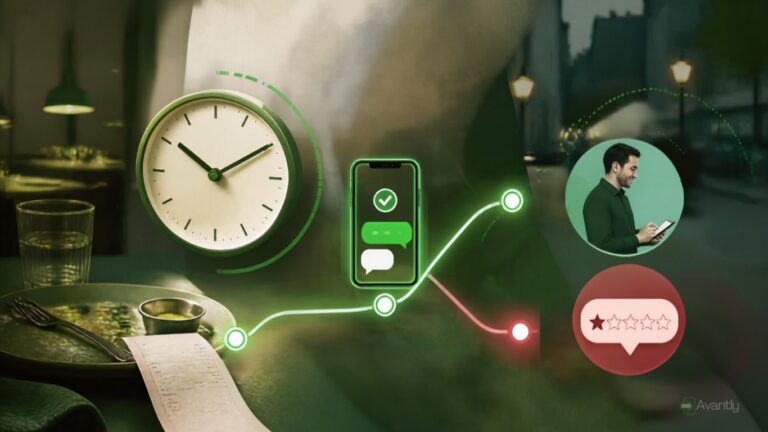
Catching Unhappy Guests Before They Post: Why Timing Is Everything in Canadian Restaurant Recovery
A guest walks out of your Burlington location on a Friday night without saying a word. No complaint to the server, no request to speak with a manager. They just leave. Forty-five minutes later, your Google rating takes a hit, and by the time your Saturday morning manager reads the review, the window to respond, recover, or even understand what happened has been closed for hours. The guest has moved on. The damage has not.
This is not a hypothetical. It is a pattern playing out across multi-location operations from Halifax to Vancouver, and it is accelerating. Research consistently shows that roughly two-thirds of guests who have a poor experience never complain directly to staff. They simply leave, and they take their frustration to whatever platform is closest to hand, usually while they are still in the parking lot or on the ride home. The emotional temperature is highest in that first hour. So is the likelihood of a public post.
What most operators have not yet built is a system that intercepts that window.
The Problem With Waiting for Feedback to Find You
Traditional feedback mechanisms, comment cards, end-of-meal surveys, follow-up emails, share a common flaw: they operate on the guest’s timeline, not yours. A guest who leaves unhappy is unlikely to seek out your feedback form. They are going to Google, TripAdvisor, or Yelp, because posting a review feels like doing something about it. It gives the frustration somewhere to go.
The hospitality industry in Canada is also navigating a staffing environment that makes in-the-moment service recovery harder than it has ever been. Tourism HR Canada has tracked persistent labour shortages across food service for several years, with turnover rates that make consistent floor presence difficult to guarantee. A seasoned front-of-house manager might catch the body language of a dissatisfied table at forty paces. A newly trained server running four too many covers on a short-staffed Saturday cannot reasonably be expected to do the same. The human safety net has real holes in it right now, and operators who are honest with themselves know this.
That is the context in which the timing conversation becomes critical. If the average unhappy guest posts a review within 60 to 90 minutes of leaving your restaurant, your recovery window is not tomorrow morning. It is tonight. Any system that does not operate within that window is not truly a recovery system. It is a reputation audit tool, which is useful, but it is not the same thing.
There is also a compounding effect that operators underestimate. One negative review does not simply reduce your rating by a fraction. It shifts the composition of reviews that potential guests read when they are making a decision. Most consumers sort by recency, not by rating. A three-star review posted last Tuesday will outrank a dozen five-star reviews from the spring. The window where damage is preventable is genuinely narrow, and it is measured in minutes, not days.
What an Effective SMS Recovery Workflow Actually Does
The mechanics of SMS-triggered guest recovery are straightforward, but the logic behind them matters. When a guest checks out or exits your point-of-sale flow, a short, human-sounding text message goes out within minutes. Not a survey with seventeen questions. Not a promotional offer dressed up as a care message. A simple, direct ask: how was your visit tonight?
Guests who respond positively can be guided toward leaving a review. Guests who indicate something went wrong, and some of them will, are routed into a recovery path. That might mean a manager response, a message offering to make it right, or a callback request. The critical design principle is this: the unhappy guest gets a private channel before they find a public one. You are not suppressing feedback. You are giving frustrated guests somewhere better to direct it, somewhere that can actually lead to resolution.
This distinction matters both ethically and practically. Guests who feel heard, even after a negative experience, are significantly more likely to return and more likely to update or not post a public review at all. The goal is not to game your rating. It is to complete the service transaction that the floor did not finish.
For multi-location operators, the scale argument is even more compelling. If you are running eight locations and each one serves 200 covers on a Saturday, that is 1,600 potential touchpoints in a single evening. Your best managers cannot personally follow up with all of them. A workflow can. The system does not get tired, does not forget, and does not miss the guest who left quietly from table 14 while your FOH team was managing a lineup at the host stand.
This is where platforms like Avantly have built something operationally relevant. Rather than bolting a generic CRM onto a restaurant context, the approach is designed around the actual rhythm of service: fast trigger, short message, bifurcated path based on sentiment. The unhappy guest gets recovery attention. The happy guest gets a nudge toward a review. Neither gets a generic mass communication that reads like a loyalty program newsletter.
For corporate operations teams managing multiple brands or markets, the reporting layer also matters. Knowing that your Mississauga location is generating twice the recovery triggers of your Oakville location on Friday nights tells you something about staffing, training, or kitchen performance that your POS data alone will not surface. Guest recovery workflows, done properly, become an operational intelligence tool.
There are a few practical considerations worth naming for Canadian operators specifically. SMS marketing in Canada operates under CASL, the Canadian Anti-Spam Legislation, which requires express or implied consent before sending commercial electronic messages. Any recovery workflow needs to be built on a compliant consent model, typically captured at the point of reservation or sign-up. This is not a barrier, it is a design requirement, and any credible vendor should be building for it from the ground up.
Privacy considerations aside, the channel itself is well-suited to the recovery use case. Text message open rates in Canada remain significantly higher than email, and the personal nature of SMS creates a different kind of engagement than a survey link buried in an inbox. Guests respond to texts faster and more honestly, which is exactly what recovery requires.
The Bottom Line
Canadian restaurant operators are managing more variables than ever: labour pressure, food cost volatility, a guest base that has both higher expectations and more public platforms to express disappointment. In that environment, hoping that unhappy guests will speak up before they post is not a strategy. The operators who are protecting their reputations most effectively have stopped waiting for feedback to find them and started building systems that go out and meet it, quickly, privately, and before the review is written. The window is real. It is short. And what happens inside it determines whether a difficult service moment becomes a recoverable situation or a permanent part of your public record.

- September 3, 2026
Catching Unhappy Guests Before They Post: Why Timing Is Everything
Catching Unhappy Guests Before They Post: Why Timing Is...


- May 12, 2026
What Surviving 2026 Actually Looks Like for Multi-Location Operators
What Surviving 2026 Actually Looks Like for Multi-Location Restaurant...